
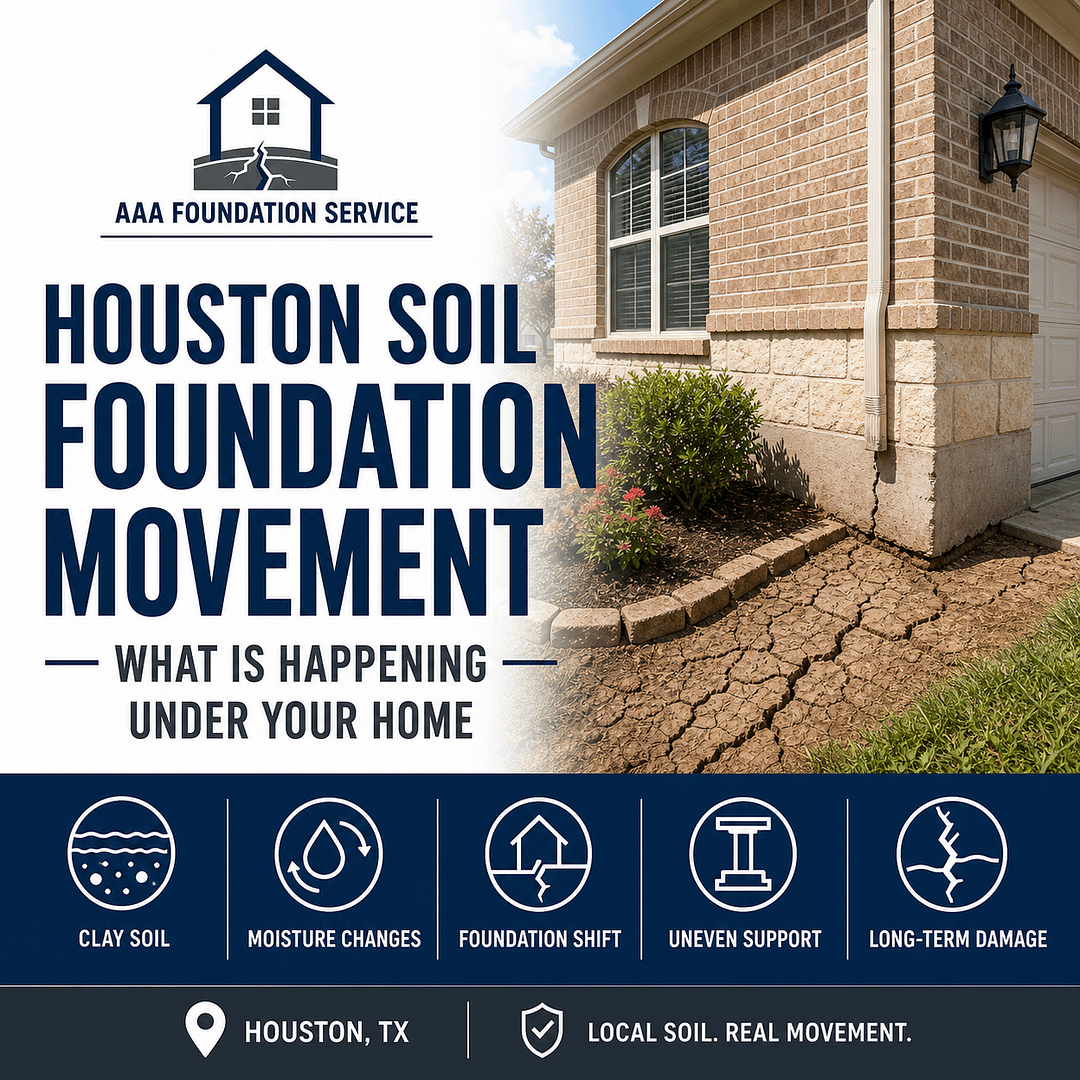
If you are seeing cracks in the brick, doors that have started to stick, or floors that feel uneven, the soil under your home is usually part of the story. Much of the Houston area sits on expansive clay. It expands when it gets wet and shrinks when it dries out, and when it does that unevenly under your home, your foundation can move with it. That does not always mean your home needs major repair. It does mean the pattern is worth understanding before you decide anything.
What the soil is doing under your home
Much of the Houston area sits on a deep layer of expansive clay, the dark, heavy soil people here call black gumbo. Clay holds water. When it rains, it takes on moisture and swells. During a long dry stretch, it dries out and pulls back. Some of the clay around Houston is very reactive and can change quite a bit in volume between a wet spring and a hard summer drought.
How much a given soil swells and shrinks depends on how much clay is in it. The clay under parts of Fort Bend County, around Sugar Land, Missouri City, and Pearland, tends to be especially reactive, which is why homes in those areas often show movement sooner. But the same basic thing is happening across most of the metro.
The layer that does the moving is near the surface, where the soil is drying out in summer and taking on water in the wet months. That is the soil your foundation sits in. A few feet down, the clay stays more stable through the year. That difference is the whole reason a proper repair reaches down past the active soil to ground that carries the load and stays put. Set support too shallow and it just rides the same moving clay.
Why the movement is almost always uneven
If the moisture changed evenly across your home’s foundation, it typically would not show issues. A home can ride a lot of even movement without much to show for it. What causes problems is uneven movement, when one part of the soil is wet and swollen while another part is dry and shrunk.
In Houston it is almost always uneven. A few common things make one part of your lot wetter or drier than another:
- A downspout that empties next to the slab keeps that corner’s soil swollen while the rest of the yard dries out.
- The sunny south and west sides of your home dry out faster than the shaded north side.
- Large trees pull a lot of moisture out of the soil during a drought and can dry the ground hard on that side of your home.
- Poor grading lets water sit against your foundation in some spots and run away in others.
- A slow plumbing leak under or beside the slab can keep one area wet year round, even in a drought.
When one area of soil holds water and another dries out, the support under your home changes from one part of the house to another. That difference is what you see as cracking and sticking doors. As a homeowner, you may start to notice cracks, sticking doors, uneven floors, or gaps around trim and brick, usually on one side or one corner rather than evenly all around.
How the seasons play into it
Houston’s weather makes the clay swing. A wet spring soaks the ground and the clay swells. A long, dry summer bakes it and the clay shrinks, sometimes enough that you can see the ground pulling away from the slab in cracks. Then a tropical storm or a heavy fall rain soaks it again. Each swing moves the soil, and your foundation moves with it.
This is why so many homeowners notice cracks and sticking doors show up in late summer and then ease off after a good rain. Movement that comes and goes with the weather like that is the clearest sign the clay under your home is active.
Which signs matter, and which usually do not
Not every crack means your home needs foundation repair. The pattern is what matters, not any single crack.
- A single hairline crack that has not changed in years is often cosmetic.
- Cracks that run diagonally from the corners of doors and windows, stair-step cracks through brick, or cracks that keep coming back after you patch them are more often tied to movement.
- Doors and windows that stick in one season and free up in another usually follow the soil’s wet-and-dry cycle.
- Sloping or bouncy floors, and gaps opening at trim or ceilings, are worth a closer look.
If you are seeing several of these together, especially after a drought or a heavy rain, that is a good reason to schedule an inspection. If you are seeing one small thing that has not changed, it is usually fine to watch it and note whether it moves with the weather.
What a good inspection looks at
A foundation problem in Houston needs to be diagnosed before it can be priced. A good inspection looks at your whole property, not just one crack in one room.
That means taking floor-elevation readings across your home to see where it sits high and low, checking the drainage and grading outside, looking at the trees and where the water goes, noting your foundation type, and reading how the cracks, doors, and floors line up with all of it. The goal is to understand the movement pattern and whether your home needs structural support, drainage correction, monitoring, or nothing at all.
If your home does not need repair, you should be told that plainly. Foundation repair is too important and too expensive to recommend without a clear reason.
Managing the moisture around your home
Because Houston clay reacts so strongly to moisture, keeping the moisture around your foundation more consistent can help, especially during long dry spells. Directing downspouts away from the slab, grading so water runs away from your home, and keeping beds and irrigation from soaking one side more than another all help even things out.
During a drought, some homeowners use a soaker hose to keep the soil from drying out sharply on one side of the home. The idea is not to flood the yard. It is slow, even moisture, run a foot or two out from the slab, so the clay does not swing from soaked to bone dry. This helps with prevention and with keeping movement steady while you monitor, but it does not replace an inspection if your home is already showing signs of movement.
What repair actually does
When your home has already moved, repair supports the parts that have dropped. Piers are set down past the active surface soil to ground that carries the load and stays stable through the seasons, usually pressed concrete pilings or bell-bottom piers, depending on your home and the access around it. The goal is to stabilize your home and bring it back toward level for its age and structure. It does not turn an older home into new construction, and an honest crew will tell you what lift is realistic before the work starts.
Where drainage or a plumbing leak is part of the problem, correcting that is often part of the plan, so the same conditions do not keep working against your home after the piers are in. Qualifying repairs come with a lifetime transferable warranty that can move with the home if you sell, subject to the written terms.
What to do next
If you are seeing cracks, sticking doors, uneven floors, or drainage problems around your home, the next step is an inspection, not a decision. AAA Foundation Service has worked on Houston foundations since 1955 and has leveled more than 30,000 homes on this soil. We will look at the full pattern, explain what we find, and let you know whether repair is needed or whether your home just needs to be watched and the drainage adjusted.
Frequently asked questions
What is Houston's black clay soil?
It is the expansive clay under much of the metro, often called black gumbo. It holds water, swelling when wet and shrinking when dry. That seasonal movement is behind most foundation problems in the area.
Does clay soil mean my foundation is failing?
No. Clay soil is common here, and many homes on it never need major repair. What matters is whether the soil is moving your home unevenly and how your home is responding. An inspection tells the difference between a cosmetic crack and active movement.
Can I keep my foundation from moving?
The soil is going to react to Houston’s wet and dry cycles. The practical goal is to keep the moisture around your home as even as possible, through drainage and, during droughts, careful watering, and to support any areas that have already moved.
Why do my cracks seem worse in summer?
During a long dry stretch the clay shrinks and your home can settle, which opens cracks and makes doors stick. After a good rain the clay swells again and some of those cracks close up. Movement that follows the weather like that is worth having looked at.
Is the clay worse in some Houston neighborhoods?
The clay is more reactive in some areas than others, and homes in the more reactive pockets often show movement sooner. But the basic wet-and-dry behavior is common across the region, so the same signs are worth watching wherever you are.
Free foundation inspection
We will tell you what is moving, why, and whether it needs repair. No obligation.

AAA Foundation Service
AAA Foundation Service has repaired Houston foundations since 1955. We inspect the full movement pattern, explain what we find, and recommend repair only when it is needed.
Seeing cracks or sticking doors?
If your home is showing any of these signs, schedule a free foundation inspection with AAA Foundation Service. We will look at the full pattern, explain what we find, and let you know whether repair is needed.



0% Financing for 18 Months
